
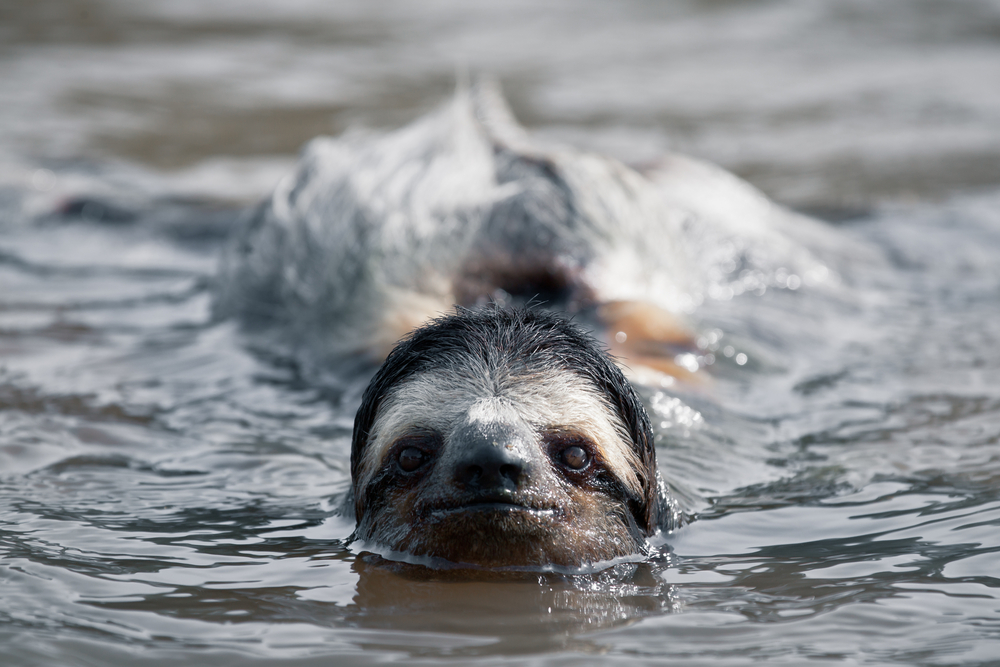
Sloths can hold their breath longer than dolphins, staying underwater for up to 40 minutes. Here’s how their unique physiology makes it possible.
A Surprising Animal Fact
When people think of animals built for life underwater, dolphins usually come to mind.
Sloths rarely do.
Yet science tells an unexpected story: sloths can hold their breath significantly longer than most dolphins.
A typical bottlenose dolphin surfaces for air every 8 to 15 minutes. Sloths, on the other hand, have been recorded staying submerged for up to 40 minutes—a remarkable feat for an animal that spends most of its life in trees.
How Long Can Sloths Hold Their Breath?
Under ideal conditions, sloths can remain underwater for as long as 40 minutes.
This doesn’t mean they regularly do so. But their bodies are built to conserve oxygen far more efficiently than many marine mammals.
Even more impressive, sloths achieve this without gills, blowholes, or specialized diving organs.
How Sloths Outlast Dolphins Underwater
Despite being slow-moving, arboreal mammals, sloths possess unique physiological adaptations that make them expert oxygen conservers.
1. Extreme Heart Rate Suppression
When a sloth enters the water, its body shifts into survival mode.
- Resting heart rate: ~100 beats per minute
- Underwater heart rate: as low as 8 beats per minute
This represents a slowdown of nearly 90%, drastically reducing oxygen consumption.
2. Ultra-Slow Metabolism
Sloths have one of the slowest metabolisms of any mammal.
Because their bodies burn energy at an extremely low rate:
- They require very little oxygen
- Stored air lasts much longer
- Muscle movement is minimized
In contrast, dolphins burn oxygen rapidly while swimming, hunting, and navigating underwater environments.
3. A Powerful Survival Strategy
This breath-holding ability isn’t a party trick — it’s a defense mechanism.
In the wild, sloths may:
- Quietly slip into rivers
- Remain submerged to avoid predators
- Escape threats such as jaguars
By staying motionless underwater, sloths reduce detection and conserve precious oxygen.
Why Dolphins Surface So Much Faster
Dolphins are elite swimmers — but that comes at a cost.
High Energy Lifestyle
- Constant movement
- Rapid swimming speeds
- Active hunting behavior
All of this burns oxygen quickly.
Even though dolphins are marine mammals, their high metabolic demands mean they must surface more frequently than a sloth resting underwater.
Important Context and Scientific Nuance
Stillness vs Activity Matters
Sloths usually reach their maximum breath-holding time by remaining nearly motionless underwater.
Dolphins rarely stop moving.
This difference alone explains much of the gap in breath-holding duration.
The 40-Minute Debate
Some scientists note that:
- The 40-minute figure comes from older laboratory studies
- More recent field observations suggest 15–20 minutes is more common
Even at the lower estimate, sloths still outperform the average dolphin.
A Final Twist: Sloths Swim Faster Than They Walk
One more surprise.
Sloths are actually up to three times faster in water than on land.
Their long arms, curved claws, and buoyant bodies make them surprisingly efficient swimmers — a skill that evolution quietly perfected.
What This Teaches Us About Nature
Nature doesn’t always reward speed or strength.
Sometimes, slowness is the ultimate survival advantage.
Sloths remind us that evolution optimizes for efficiency, not appearance — and that even the slowest animals can outperform ocean athletes in the most unexpected ways.