
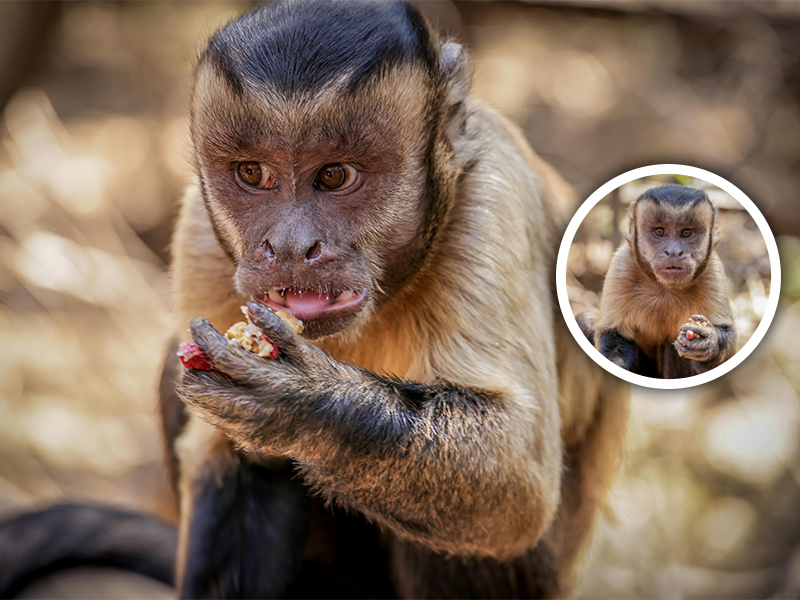
A Behavior That Looks Simple — But Isn't
At first glance, watching a capuchin monkey rinse food in water may seem ordinary. But science tells a far more complex story.
Capuchin monkeys (Cebus and Sapajus) do not wash their food out of instinct. Instead, this behavior is deliberate, learned, and highly strategic, shaped by environmental pressures and advanced cognitive abilities.
Researchers now recognize food-washing as a problem-solving behavior—one that reveals how intelligent these small primates truly are.
The Real Reason Capuchin Monkeys Wash Their Food
Grit, Sand, and Dental Survival
The primary driver behind food washing is dental protection.
In many capuchin habitats, food is frequently contaminated with:
- Sand
- Quartz particles
- Fine grit
Repeated chewing of abrasive materials can cause severe, long-term tooth damage, reducing feeding efficiency and survival chances.
By rinsing food before eating, capuchins significantly reduce this risk.
More Than Cleanliness: Taste and Safety
Food washing offers additional benefits beyond grit removal.
Capuchins also rinse to:
- Remove unpleasant or bitter tastes
- Reduce irritating plant fibers
- Eliminate potential parasites
This makes food both safer and more palatable, increasing nutritional intake and overall health.
Strategic Thinking: Time vs Risk
Food washing is not automatic.
Studies show that capuchins make cost–benefit decisions before washing.
- Dominant individuals often skip washing to eat quickly and secure resources
- Subordinate monkeys are more likely to wash food, prioritizing dental safety over speed
This indicates decision-making based on social status, risk tolerance, and environmental conditions.
Exceptional Hand Control and Motor Precision
Food washing requires remarkable physical skill—and capuchins are uniquely equipped for it.
Advanced Hand Anatomy
Capuchins are rare among New World monkeys in having pseudo-opposable thumbs, enabling both strength and precision.
This allows them to:
- Hold food securely
- Rotate and rinse items carefully
- Control grip pressure with accuracy
A Wide Range of Precision Grips
Researchers have documented around 16 different precision grip types in capuchins.
They frequently use:
- The distal lateral thumb
- The index finger
This grip combination allows them to manipulate small food items with extreme care—comparable to Old World monkeys like macaques.
The Brain Behind the Behavior
The intelligence behind food washing is rooted in neural complexity.
Capuchin brains contain:
- Well-developed somatosensory maps
- Advanced motor planning regions (parietal areas 2 and 5)
These structures support:
- Visually guided movements
- Sequential task planning
- Fine motor coordination
Such brain organization was once thought to be limited to humans and a few other primates.
Food Washing as a Cultural Tradition
Learned, Not Inherited
Food washing in capuchins is classified as a protocultural behavior.
This means:
- It is not innate to the entire species
- It spreads through social learning, not genetics
Some groups wash foods like sweet potatoes, while neighboring groups do not—clear evidence of regional traditions.
How Young Capuchins Learn
Young monkeys often observe older troop members, but direct imitation is rare.
Scientists believe the behavior emerges through:
“Individual discovery within a supportive social context.”
In other words, monkeys learn because they are in a group that already values the behavior—not because they are copying step by step.
Why This Behavior Matters
Food washing places capuchins in an elite group of animals capable of:
- Understanding cause and effect
- Modifying behavior based on environment
- Transmitting knowledge socially
This level of cognition challenges the idea that complex problem-solving is uniquely human.
A Window Into Primate Intelligence
Capuchin monkeys remind us that intelligence comes in many forms.
Through something as simple as washing food, they demonstrate:
- Planning
- Risk assessment
- Cultural learning
- Advanced motor control
What looks like a small habit is, in reality, a powerful example of evolutionary intelligence at work.