
Nature’s Free Antidepressant
Listening to birdsong mental health benefits are more powerful than you think. You step outside in the morning, and a sparrow starts its routine chatter. Then a robin joins in. Before you know it, the air fills with a chorus of chirps and trills. Most of us ignore it, but what if that daily concert is doing more than just signaling the start of a new day?
A growing body of research suggests that listening to birds sing isn’t just pleasant—it’s a powerful, natural intervention for your mental health. Studies show it can lower anxiety, reduce paranoia, fight off sadness, and boost your overall sense of well-being for hours at a time.
The Science of Chirps: Birdsong Mental Health Benefits Explained
For a long time, researchers focused on how seeing nature—trees, oceans, mountains—benefits our mental health. But in recent years, the focus has turned to our ears. Scientists are discovering that what we hear in nature is just as powerful as what we see, if not more so.
The findings are striking. In a 2022 study, researchers from King’s College London tracked over 1,300 participants’ mental well-being in real time. When people saw or heard birds, their mental well-being improved significantly, and the effect lasted for up to eight hours. These benefits were observed in both healthy individuals and those with a clinical diagnosis of depression, the most common mental illness worldwide.
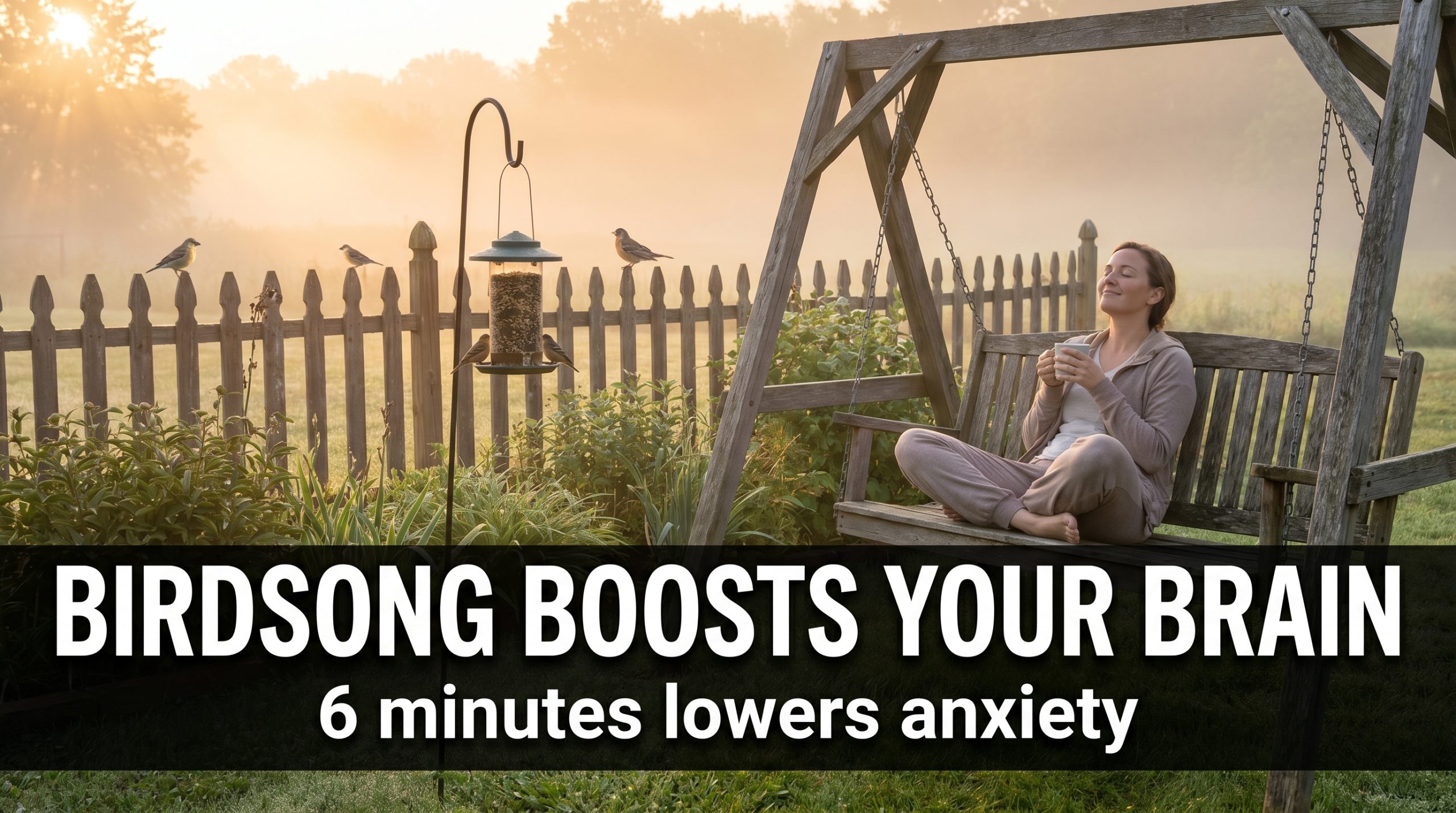
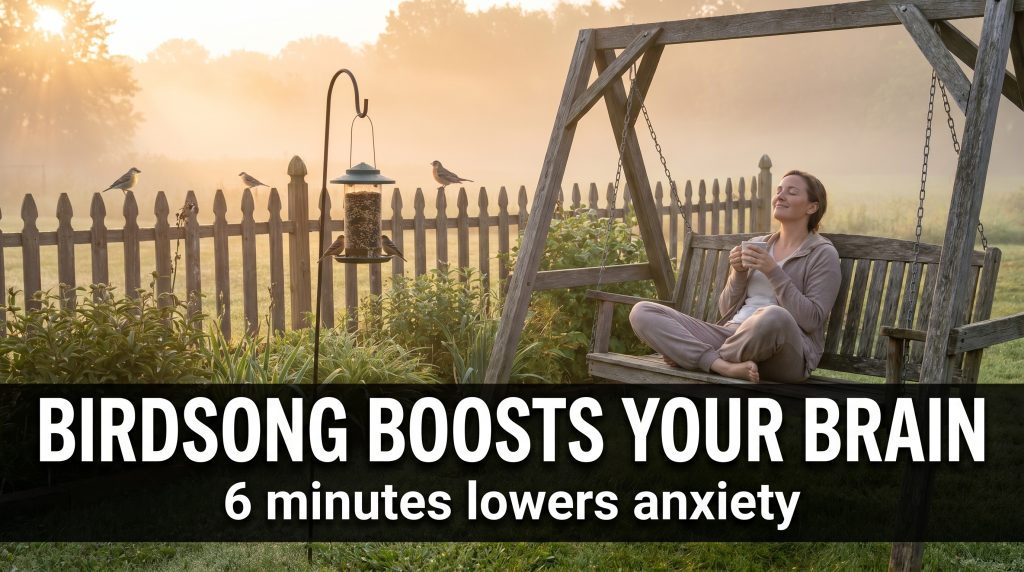
Another 2022 study published in Scientific Reports found that listening to just six minutes of birdsong could reduce feelings of anxiety, depression, and paranoia in healthy participants.
These aren’t just fleeting feelings of “niceness.” In a 2025 study, birdsong was found to be as effective as audio-guided mindful breathing at reducing sadness, offering even greater benefits for physiological recovery in individuals with depressive symptoms.
The “In Depth Fact” — This is More Than Just a “Nature Boost”
The benefits of birdsong go beyond the general effects of being outdoors. Researchers have found that its positive impact remains strong even when accounting for other environmental factors like the presence of trees, plants, or waterways. Birdsong has a unique and powerful effect on the human brain that stands on its own.
1. A Signal of Safety
From an evolutionary perspective, birdsong is an acoustic all-clear signal. Clinton Francis, a biology professor at Cal Poly, told National Geographic that when birds suddenly stop singing, it’s often a cue that a predator is nearby. Over human history, hearing birdsong has likely become a reliable sign that our environment is safe and we can relax.
2. Active Engagement Matters
Noticing the sound is key. A 2025 study led by the University of Surrey found that actively listening to birdsong, rather than just hearing it as background noise, produces much stronger restorative effects. The benefits come from consciously engaging with the sound.
3. The Right Volume
The sound level also plays a role. A February 2026 electroencephalographic (EEG) study found that moderate-level birdsong (around 45–50 decibels) enhanced psychological restoration and increased alpha brainwave activity, a sign of mental relaxation. However, at 60 decibels, birdsong actually increased EEG markers of mental stress, suggesting there is a “Goldilocks zone” for volume.
4. Birdsong vs. Traffic Noise
The research highlights a stark contrast between natural and human-made sounds. In the 2022 study, the same participants who listened to birdsong also listened to audio clips of traffic noise—car engines, sirens, and construction. While birdsong improved mood, the traffic sounds increased feelings of depression.
Here are key studies proving the birdsong mental health benefits
How to Get Your Daily Dose of Birdsong
The good news is you don’t need to live in a national park to benefit. Here are simple, actionable ways to bring more birdsong into your life.
- Start Your Day with an Open Window: Begin your morning by opening a window for 5-10 minutes. Before checking your phone, just sit and listen. Pay attention to the different calls and chirps to turn it from background noise into an active mindfulness practice.
- Create a Bird-Friendly Backyard: Make your home a hotspot for feathered friends. Hang a bird feeder, provide a shallow dish of fresh water for drinking and bathing, and plant native berry-producing shrubs like rowan or holly.
- Use Birdsong Recordings: Research shows that listening to recordings, even through headphones, can alleviate negative emotions. Use apps or nature sound videos on YouTube when you’re stuck indoors or dealing with urban noise.
- Turn Your Walk into a Bird Walk: Instead of wearing headphones, leave them at home and let birdsong be your soundtrack. Actively listen for different songs and try to spot the bird making each sound to enhance the restorative effects.
Conclusion: Tune In, Feel Better
The world can feel loud, chaotic, and stressful. We often search for complex solutions to feel better when a simple, free, and scientifically proven one is singing right outside our window. Birdsong is a signal of safety, a natural remedy for anxiety, and a powerful tool for mental clarity.
So, the next time you hear that dawn chorus, don’t let it fade into the background. Stop, listen, and let nature do the rest.